Tuesday, June 19, 2012

THE YEAR OF THE BUTTERFLY


Through the years I have watched videos and marveled at photos of migrating Monarch butterflies. Usually each spring brings the Monarchs here in sparse numbers. It was always a hallmark of spring to see them flutter in for the first time. Following the appearance of the "local" hibernating butterflies, such as the Mourning Cloak and Compton's Tortoiseshell.


Mourning Cloak Compton's Tortoiseshell


 This spring, an infestation of orange and yellow butterflies have literally painted the landscape. First, the Monarchs flew in on a howling south wind. Tens of thousands orange and black butterflies seemed to be everywhere. They were like Christmas tree ornaments, hanging on the blossoms of the pin cherry trees.


It seemed every wildflower that bloomed had a perched Monarch Butterfly.


It seemed not to matter where you walked or hiked in the arrowhead, the Monarchs were omnipresent. I hated to get in the car to drive anywhere, because they also dotted the roadways. 


To make things even more colorful, another butterfly phenomenon occurred. The Canadian Tiger Swallowtail butterflies decided not to be outdone by the infiltrating Monarchs. They also flew in by the thousands, creating a butterfly spectacle never before seen in my lifetime... or by other old timers on the north shore.


Smaller versions of butterflies mingled with the large Monarchs and Canadians. Spring Azures and Red Admirals were also as numerous as I have seen them.


Spring Azure


Red Admiral


 The Harris Checkerspot is like a miniature version of the Monarch, a particularly lovely butterfly.


 Harris Checkerspot


 One of my favorite tiny butterflies that just arrived is the Eastern Tailed-blue. It is difficult to tell the difference between him and the Spring Azure.  I have seen many Painted and American Lady butterflies along with these colorful butterfly imitators, the Luna Moth.


Eastern Tailed-blue


 More butterflies wait on the horizon, the fritillaries are now flying in, so I suspect the remainder of the summer will sport unending color.
"May the wings of the butterfly kiss the sun 
And find your shoulder to light on,

To bring you luck, happiness and riches
Today, tomorrow and beyond."
                  ~Irish Blessing

Thursday, June 14, 2012

THREE HUNDRED MILES OF ARROWHEAD WILDLIFE


A windy day in May, I took a 300 mile wildlife photo junket with my friend Paul. Our first stop was a Red Fox den that had three kits and their parents. We were pleasantly surprised that mother fox greeted and checked us out. 


 Evidently we passed the non threat test and she returned to the den and brought out the kits.


We stayed there for an hour or so, watching the kits play and chase each other.


Our next stop was an eagles nest on a lake not too far from the fox den. We spent another hour or so, watching the parent eagles flying in with food for the eaglets. On this nest, we never saw the eaglets.


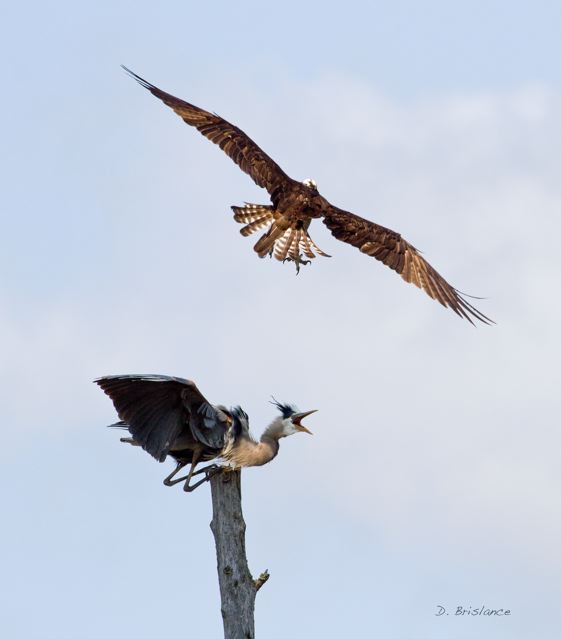
We had a difficult time finding the heron rookery. When we found it, we had to battle a thirty mile an hour wind taking photos. At least the dreaded black flies were held at bay by the strong wind. The most interesting shots occurred when a Great Blue Heron got too close to an Osprey nest... the following sequence pretty much sums up the disdain of the Osprey and "interesting" facial expressions of the heron. Who said birds are expressionless. 

 "Zeroing In" 


Another highlight was whistling in a particularly beautiful White-throated Sparrow. He alighted close to me and was not too enamored with my presence in his territory.


Leaving the heron rookery and the dazed Great Blue, we meandered back toward home. Our next stop was a Pileated Woodpecker nest, where mom was sitting on eggs. We managed to snap a few shots when she peeked out of the nest. 


The last stop on our whirlwind tour was another eagle's nest, this one on the shore of Lake Superior. We had to set up our blinds, to make our presence non threatening to the parent eagles. The eaglets were at eye level, so we got a few shots of them enjoying the warm sunshine, before we had to leave.


It is not too often each planned stop, yields such a variety of unique photos. It was a day when observing the images were as inspirational as mastering them.


“Adopt the pace of nature:  her secret is patience.”  ~Ralph Waldo Emerson

Saturday, April 7, 2012

DESIGNER DUCKS


Through the years, I have not photographed many ducks or water birds. I have stayed pretty much in the forest land of my ridges, chronicling warblers, sparrows and other songsters. In the past year, I have met another Arrowhead wildlife photographer that lives close to me on another ridge around the Superior National Forest. He has two ponds on his property and sets up a blind on each pond. Recently he is on vacation and I got the "tough task" of checking the ponds and seeing who and what flies in.

The other morning, I arrived at one of the ponds before daybreak to see what would fly in. It still is a bit chilly at 30 degrees, but the wind was still. I sat in the stillness and listened to a Winter Wren singing and a chorus of frogs croaking loudly. Suddenly I heard the "swoosh" of water across the far end of the pond. A bright, white breast of a duck shone in the pre dawn light. I looked through the lens of my 300 and it was a Northern Shoveler, cruising towards me. I had to chuckle, because I had photographed this same duck the day before in my friend's other pond... in much better light. I sat watching him when I heard a scratching along the edge of the blind. A brown furry head appeared by my foot and sat looking at me... it was a deer mouse checking me out. I always carry hulled sunflower seeds in my jacket for my chickadees, so I dropped a few by his nose and he proceeded to have breakfast sitting by my foot.
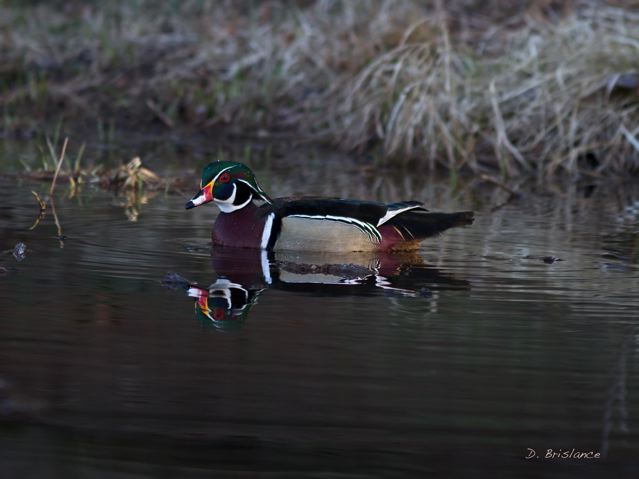
In the mean time, my "Designer Mallard", who I call my Northern Shoveler friend, was directly in front of my blind. It was still too dark to photograph, so I watched him "paddle and tip" for breakfast. A startling "plop" broke the silence. A beautiful, drake Wood Duck dropped out of the sky. He paddled directly over by the shoveler and then sat in front of the blind. I was lamenting the darkness at this moment. What a view of this beautiful bird... I didn't dare take shots at this moment, because I thought first of all I would frighten him. It also was still too dark. I watched him for sometime and finally the sunlight appeared at the tops of the trees, far across the pond. I thought, "What the heck" and clicked off a few shots of him along the shore. He paddled to the middle of the pond and took off as fast as he appeared. I was upset at the fact that he left before dawn broke with no good shots, but at least I got the closest look I have had at a Wood Duck... who I think is the epitome of a "Designer Duck."


I sat and watched the shoveler for another ten minutes or so, when the Wood Duck dropped in again. This time is was lighter and I managed to finally get a few keeper shots of him.


He unfortunately left again in an abrupt fashion and never returned.

"Behave like a duck, unruffled and calm on the surface, but paddling like the devil below the surface."

Sunday, March 11, 2012

GRACE


Common Redpolls & Pine Siskin

First of all, my birds are fiercely "Independent." They are not "left" or "right winged"... if they were, they could not fly.

Maybe politicians, there is a lesson here.

My birds survive hawks, shrikes, blizzards and below zero temperatures. They are even tempered (except for a few of my Red-breasted Nuthatches); they are for the most part model parents. Their mentoring skills are off the charts and their loyalty is unwavering.


Black-capped Chickadee

Thievery is not tolerated. I once had a White-breasted Nuthatch that would follow me, my little flock of chickadees and Red-breasted Nuthatches in the forest. The White-breasted Nuthatch would never come to my hand for seeds, but follow the Red-breasted Nuthatch. When the RBN would take the seed out of my hand, he would fly to a tree and pound the seed into a bark crevice. He then would take a piece of lichen and cover the seed to hide it... then fly back to my hand and start his routine again. In the meantime, the WBN would find the stored seed in the tree bark and "pry & pilfer." She was a scoundrel of major proportions. These antics went on for a few days, but soon were stifled. Mr. RBN caught her in the act and would not tolerate the continued theft of his hard earned seed. He chased her though the brush and trees like an out of control fighter pilot... eventually out of sight. I hated to see her go, the WBN is a fairly rare bird on my ridge... but the "law of the jungle" is swift and just.

Common Redpoll

Neighborhood Watch. My birds depend on each other. When a predator invades, they warn each other by incessant, robotic chirping. Much like a flock of crows driving an owl insane, but without the brash, winged attack. My birds are aware until the danger is passed.

Pine Siskins

Well mannered. My birds, especially the Black-capped Chickadees respect their elders. When they fly to my hand in the forest, they wait their turn. Mom and dad will feed the fledglings seeds until they feel it is right for the "kids" to take seeds out of my hand. The children invariably wait for mom and dad to eat first.

Common Redpoll

Grace. One of the definitions of grace is beauty in motion, form or action. A term that is endearing and understood by the avid birder and nature lover. I think because of this definition, many humans desire to care for and feed birds... they enjoy birds presence and beauty. I also believe that part of the biblical definition of grace also holds true here. Grace means free gift... and I, like the "Wizard of Oz" am the man behind the curtain, distributing seeds by grace as a free gift.

Pine Siskin


Black-capped Chickadee

Now, if my little Red-breasted Nuthatch could understand that "forgiveness is also a free gift." He would pass along a little "grace" to the White-breasted Nuthatch and welcome her back to the ridge.

Red-breasted Nuthatch


"Grace means accepting the abandoned one." Yrjo Kallinen