Friday, February 25, 2011

COMMON & HOARY REDPOLLS


Earlier this week, my friend Al from Rainy River, suggested to me that it might be interesting to post a comparison of the Hoary and Common Redpolls. This has been a good year for redpolls in my area... unfortunately, last year I saw two, all winter... while in 2009 there was an infestation of thousands in the Arrowhead region; as well as other areas of the northern USA.

The Hoary Redpoll has flown in at different times this winter season. I usually see a couple with the Common Redpolls every now and then... but this year there have been more than usual, at least in my area.

There are two redpoll species... the Common and the Hoary. Both have two subspecies breeding in North America... so there are four subspecies of redpolls...

The Southern Common Redpolls - more streaked flanks and under tail coverts, this subspecies seems to get mixed up more with the Hoary because of the varied whiter flanks and under tail whiteness... plus the different pinkness and reds of the breast.

Common Redpoll

Common Redpoll

Common Redpoll

Common Redpoll

Common Redpoll

The Southern Hoary Redpoll - breeds in the southern parts of the Arctic, overlapping with the Southern Common Redpoll, which I assume is the reason there are always intermingled sightings. The Southern Hoary Redpoll is paler by comparison to the Southern Common Redpoll. The neck and back of the Hoary Redpoll is whiter than that of the Common Redpoll. This Hoary Redpoll has less dark streaks on the flanks, sometimes non existent; plus the under tail coverts are usually pure white, without any streaking or brown "dashes." The more difficult ID in my opinion, is recognizing the stubby or shorter bill length on the Hoary.

Hoary Redpoll

Hoary Redpoll

Hoary Redpoll

Hoary Redpoll

The Greater Common Redpoll- is a larger sized redpoll that breeds in Greenland and on Baffin Island. I have never seen this subspecies, but I would imagine my friends in eastern Canada have.

Hornemann's Hoary Redpoll- breeds in the high Arctic and Greenland. A larger, whiter redpoll with the faintest streaking on the flanks... often described as having no streak marks at all on the under tail coverts... I don't think I have ever seen this bird as it would be a rarity in my range.

Since the Hoary Redpolls breed in similar areas as the Common Redpolls, I always wonder why they are fewer than the common cousin in my area. Even in 2009 when I had the redpoll "infestation" or "eruption" caused by pine cone and seed shortages in the far north, I saw fewer Hoary Redpolls than I have this year.

On my ridge, there is one thing for certain, they provide a varied beauty of "rosiness" to a stark, white, winter world.
__________________

BLACK-BACKED WOODPECKER REDUX


A few days ago, I walked up one of my ridge trails to feed my chickadees. I began to think I could have stayed in my yard, because most of the chickadees are there at my winter feeders... but a number of them came along when I whistled for them and ate hulled sunflower seeds from my hand. I positioned myself by a deadfall covered with lichen, so I could get a few photos of them on the decorative branches.

Black-capped Chickadee

I was with them for a half hour or so, when I heard a familiar "tapping" sound from a cedar wash about a hundred yards away.

I walked through the deep snow onto the packed down deer trails in the cedars. I would stop and listen for the pecking sound, because I was quite sure I had heard a Three-toed Woodpecker. Over the years, I have learned to discern the rhythm and torque of the three-toed variety. It is quite different sounding from the Downy and Hairy Woodpeckers... the intermittent pecking is a giveaway, as they stop to pry and scrape the dead bark away on the dead spruce... searching for the spruce beetles, larvae, etc. When I heard his tell tale "chirp", I knew it was one of the three-toed woodpeckers.

Black-backed Woodpecker

I waited until he resumed pecking; this blue collar woodpecker is so focused on his work, that if you are patient, you can walk right up to him... which I have done many times.

Black-backed Woodpecker

This time it happened to be the Black-backed Woodpecker, who used to be called the Arctic Three-toed Woodpecker... the lessor observed one of the north woods is the Three-toed Woodpecker; which has a ladder back and is a tad bit smaller. The bonus with this little beauty was that he was the male, with the perfect yellow "dollop" decorating the top of his head.

Black-backed Woodpecker

I proceeded to take a number of photos and spent quite a bit of time watching him work, until a red squirrel came into the area and chased him away...

Nemesis

I don't get a huge diversification of birds here in the winter, so the finding and capturing one of the sought after "recluse woodpeckers of the north woods," was a highlight of my winter.

Thursday, December 16, 2010

ONE REASON TO WINTER IN THE NORTHLAND


When the first snow flake falls on the north shore of Lake Superior, "the question" is inevitably asked me, "Do you stay here for the winter?" More often than not, the hope of an affirmative yes can be seen in the eyes of the questioner.... I always have the feeling my yes answer, validates their sanity.

First of all, there are many reasons Mary and I choose to winter on Cedar Ridge. A few I have alluded to in past posts, but the main reason is we enjoy all the wildlife seasons here on the north shore. Each season spotlights varieties of different birds and animals and we would greatly miss these events.

One of these events is the winter return of the Gray Jay, aka Canada Jay, Whiskey Jack, Camp Robber or Chickadee on Steroids. The winters of 2008 and 2009 were void of this gregarious bird of the north and we greatly missed his presence. This fall on November 5th our "reason not to go south" flew in to our yard. A beautiful immature Gray Jay landed in our front yard cedar tree. I immediately cut some small pieces of beef summer sausage our Gray Fox enjoys and tossed it on our patio. Without hesitation, the gray one dove in and helped himself. I added a few cubes of bread and he flew back and forth from the forest gathering up his new found booty.

Usually when you begin feeding a Gray Jay, they hang around for the duration, that being the winter and then departing in the spring to their breeding areas. This guy stayed for the remainder of the day and then disappeared for the next day or so. I thought my theory of "feed and stay" did not apply to this bird... but about the time I thought he had continued on his way, he returned. Now I was prepared with all the jay's favorites: white wieners (the cheapest and worst looking), hamburger morsels and white bread cubes. The gray one will pretty much eat any meat scrap you throw out the door. I do know that they have an affinity for baked beans... and I have friends that have watched them steal hot dogs off a grill and chips off a picnic table. Thus the appropriate handle, "Camp Robber."


The Gray Jay is arguably the most social of the birds of the northland. They thrive on contact with humans; obviously because we return their affection and bravery with the food they love. This new arrival took food out of my hand on the second day he was here. He comes every morning at sunrise and returns intermittently during the day. Every afternoon at sunset, which is now around 4:15 pm, he flies in to "pork down" for the long, cold night.


We received a surprise soon after his arrival, when another Gray Jay accompanied him into the yard. At first he was not too enamored with the new arrival, but soon they were both flying in together. The new guy would not land in my hand to grab his scraps, he would perch in a cedar or on my suet post and watch his friend land in my hand. He always waits for the original jay to eat first, then he flutters in and waits for me to toss his scraps on the ground. I am wondering if he will someday eat out of my hand before he leaves in the spring.


Mary and I love to watch them flutter from long distances into the yard. They have the longest and most beautiful glide to my outstretched hand. Yesterday I placed a slice of hot dog, piece of hamburger and bread cube in my hand. I was curious to see which one he would choose. He landed in my hand, perused the buffet and proceeded to scarf up the hamburger, hot dog and bread cube in that order... leaving none behind.


The Gray Jay's range is extensive throughout Alaska and Canada; in the U.S.A. he flies the northern border states from Minnesota, east to Maine... the northwestern states of Washington, Oregon and a finger extends throughout the Rocky Mountain range south into New Mexico.


Where ever he is seen, he provides endless delight and entertainment for the birder, hiker and camper... as the book "Birds of America" states: "He is about the cheekiest thing that wears feathers."

Saturday, October 30, 2010

SNOW BUNTINGS & LAPLAND LONGSPURS


The past couple weeks I have been fortunate to photograph Lapland Longspurs and Snow Buntings. They have been passing through here each day and landing in an old gravel area next a road that leads into my driveway. Each morning I have been staked out by some small spruce trees, waiting for them to land and feed on weeds and seeds.

Lapland Longspur

Snow Bunting

Lapland Longspur

Lapland Longspur

I have spent many hours watching the longspurs and buntings... and have begun to understand their quirky flight habits. It seems that each flock closely resembles a kindergarten class. I see the "line leader" swoop in and perch on a taller weed or rock. He almost always is the most colorful male of the flock and peruses the area and may peck a few seeds. He then either flies off and brings back the rest of the flock or the flock joins him in his newly found area.


Snow Bunting

I slowly move towards them taking a few steps and then waiting five minutes or so... then repeat until they are used to my presence. This goes on until the "line leader" cheeps and they are off with their flashing, white wings. More often than not, the flock will fly in a large circle and land almost in the same spot or a short distance away. Once, they flew in the circle and I had them land a few feet from me... to close to focus with the 400.


Snow Bunting

John Burroughs rises to his best literature as he speaks of the Snow Buntings ("Far and Near"): "The only one of our winter birds that really seems a part of the winter, that seems to be born of the whirling snow, and to be happiest when storms drive thickest and coldest, is the Snow Bunting. The real snowbird, with plumage copied from the fields where the drifts hide all but the tops of the tallest weeds, large spaces of pure white touched here and there with black and gray and brown. Its twittering call and chirrup coming out of the white obscurity is the sweetest and happiest of all winter bird sounds. It is like the laughter of children. The fox-hunter hears it on the snowy hills, the farmer hears it when he goes to fodder his cattle from the distant stack, the country schoolboy hears it as he breaks his way through the drifts toward the school. It is ever a voice of good cheer and contentment."


Snow Bunting

It is a celebration for me, to have the opportunity to observe these beautiful tundra birds at close range. I think they are the most uniquely marked birds I see in the late fall and arguably the most docile along with the Lapland Longspurs. I look forward to the return of these beautiful birds in the spring... adorning their gorgeous breeding plumage.

Lapland Longspur... spring breeding plumage

Snow Bunting... spring breeding plumage

"One bleak March day,...a flock of snow-buntings came...Every few moments one of them would mount into the air, hovering about with quivering wings and warbling a loud, merry song with some very sweet notes. They were a most welcome little group of guests, and we were sorry when, after loitering around a day or two, they disappeared toward their breeding haunts." Theodore Roosevelt

Thursday, October 14, 2010

ENTERING WINTER


October on the ridge is usually a month of transition. Last year at this time we had snow on the 10th of October and lows the last half of the month in the 30's and 20's. Then November and deer hunting arrived and we ended up with warm temps and golfing weather.

Now in mid October, we have enjoyed warm temperatures with highs reaching the 60's and 72 on October 9th. The fact of the matter is, so far, the whole 2010 year has been incredibly warm and pleasant.

We had a half dozen or so deer we fed in our yard this past winter. Usually they stay until the middle or end of April and sometimes the first week of May. This year, they exited in mid March because of the exceptionally warm temps. Here on our ridge we had a grand total of 18 inches of snow for the entire 2010 winter. Inland there was "thigh high" snow at mid winter, but all we got was rain off the Big Lake. I took photos of drumming Ruffed Grouse in a light Gore-tex jacket the whole month of April.

The spring advent of the wood warblers was quite disappointing, as mentioned in a previous post. A number of species either by passed our ridge, flying at night or completely blew us off, missing us for the entire nesting season. In the breeding and nesting season of 2009 we identified 21 species of warblers. This year we spotted 16 species and in 2008 we saw a grand total of 23 species. I had hoped because of the wonderful weather the warblers would have a banner year. It ended up being the opposite, with an added negative, full blown leaves... two weeks early.... making warbler observation and photographing, difficult at best.

Each fall, the media weather prognosticators, gaze into their crystal balls and make an educated guess about the impending winter wrath. If their predictions are anything like the year of 2010, they will be dead wrong.

I always used two scenarios in my winter prediction: 1. the width of the band of the "Wooly Caterpillar." 2. An elderly Native American gentleman used to fish on the banks of a creek that flowed behind my house. I would sit and listen to his historic stories about past Native American encampments in the area of my house. The topic of winter came up. I thought that certainly, this wise old sage would enlighten me with a similar wise prediction. Not missing a beat, with a twinkle in his eye, he said.... "By the the size of the white man's wood pile, it is going to be a bad one." .... This year the 40 pound bags of wood pellets, for our pellet stove are piled quite high. We will see if the snow matches their height....

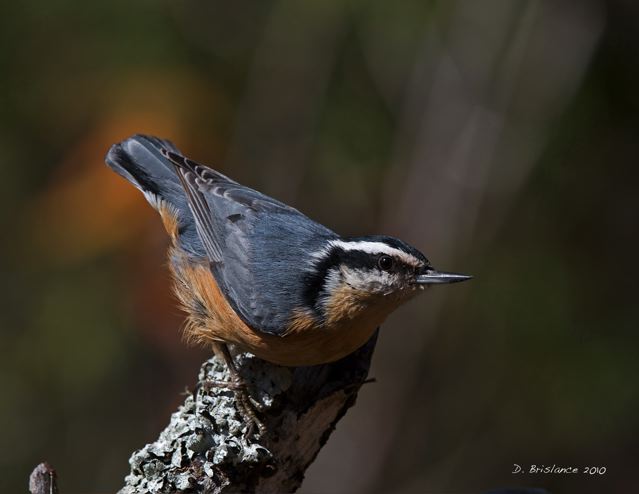
The first 14 days of October had interesting birds stopping by. Some are my "usual suspects" that remain here with me all winter, such as the Black-capped Chickadees, Red-breasted Nuthatches, Blue Jays, Bald Eagle and the Downy Woodpecker.

Bald Eagle


Blue Jay


Black-capped Chickadee


Black-capped Chickadee


Downy Woodpecker


Red-breasted Nuthatch


Others such as the Winter Wren, Fox Sparrow, Dark-eyed Junco and Lapland Longspur are passing through.

Winter Wren


Winter Wren


Fox Sparrow


Dark-eyed Junco Juvenile


Lapland Longspur


The Purple Finch seems to be here at various times throughout the winter months.

Purple Finch


A couple more of my friends that flew in...

American Tree Sparrow


White-breasted Nuthatch


And one that trots in each night...

Gray Fox


"Entering Winter" can be like a slamming storm door or a slow progression of "Indian Summer Days." I have discussed this proposition with my chickadees and nuthatches and we all hope it is the latter.

Tuesday, September 21, 2010

HAWKS & JAYS

In the Minnesota arrowhead, September is the key month for migrating hawks.
Also, impressive numbers of migrating Blue Jays are being seen all along the North Shore, including a record-high count of 7,612 on the 14th at Hawk Ridge in Duluth.


Broad-winged Hawk


American Kestrel


Red-tailed Hawk


Cooper's Hawk

The migrating Blue Jays are not only impressive in numbers, but impressive in their degree of handsomeness. I enjoy photographing "His Blueness" this time of the year, as each jay has perfect feathers. These long distant, deep woods jays are in flocks numbering in the teens, to the hundreds... it is quite a sight to see as they pass over my ridge.


Blue Jay

I am entertained by their antics around the invading, small Accipiter hawks. Unlike my little birds, the chickadees and RbNuthatches who chant their robotic chirps and then hide in the trees... the robust Blue Jays taunt the Sharpies and Cooper's. The hawks dive at the jays and they hop or fly out of the way... at times, they sit above or around the hawks in the trees and pretty much drive them nuts. The one pictured in this series was worn out by a morning of chasing the elusive Blue Jay.


Sharp-shinned Hawk

At this date, 35,396 hawks, Merlins, falcons, eagles and Turkey Vultures have flown over Duluth and Hawk Ridge.