Saturday, July 11, 2009

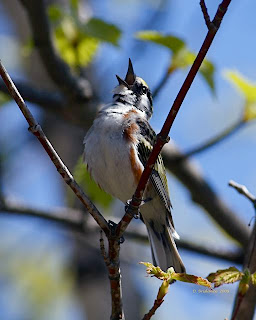
CHESTNUT-SIDED WARBLER


The nesting is over for most of the spring migratory birds. My old faithful birds, who I call the "usual suspects", have their chicks flying around like fighter pilots... that would be the chickadees and Red-breasted Nuthatches. Besides the ravens, the Red-breasted Nuthatches fledged early this spring and the juveniles are already eating sunflower seeds from my hand.

This morning, I probably took my last photo of the Chestnut-sided Warbler chick. I have been following mother chestnut since the early designing and building of her nest.


She picked up her first strand of dried grass and started her nest construction on June 1. It took her four days to finish her nest, it is constructed entirely out of dried grasses.


The nest was built in a low hazelnut shrub only 2 1/2 feet off the ground. It is completely hidden and surrounded by northern bush honeysuckle. During the first week in June, it was easier to see the nest, because the leaves had not fully matured. As time went by, the whole nest became engulfed in leaves and the nest was impossible to see.

I checked on the nest each day in June. I could walk up to the nest and take a long twig and move a leaf to see if mother chestnut was sitting on eggs. At times the nest was vacant, but she laid her eggs soon after the nest was built. I could never tell how many were in the nest, but I know there were at least three. I didn't want to intrude too often, so I checked the eggs only once.

One thing I have learned about birds, is that most respond differently to humans in the vicinity of their nests. The Hermit Thrush for instance, raises quite a ruckus when I check her nest. She "Peeps" and carries on, trying to draw me away from the area. The Winter Wren and the Indigo Bunting do the same thing. The Chestnut-sided Warbler, however, goes about her business as if I am not in the area. This is true while she is building the nest, feeding the chicks or when I walk up to the nest. I have found after watching the chestnut for years, this has never varied. When I am staked out on a photo shoot, she will fly a couple feet from me, picking up insects. I have had them fly directly at me and sit on a nearby branch resting and preening. I think they are the most social of the wood warblers that we have inhabiting our ridge. We usually have at least 22 species of warblers passing through here each spring.

Each day I stood in the same spot by a large patch of hazelnut bushes, watching the trips by both parents to the nest. I knew that the chicks had hatched. The minute I would arrive at my post, the male chestnut would fly into the bush and check me out. Mother chestnut knew who I was and never stopped or missed a beat. They basically could care less having me in the area.


The chicks left their nest on June 30, I know that because I had to chase a Pine Marten out of the area on that date. I had watched the chestnuts make many trips to the nest in the morning and in the afternoon the nest was empty. I sat on a log close to the nest area and waited for the parents to show up. It wasn't long before the mother chestnut flew in with an insect, landing in a small spruce. I carefully walked to the spruce, knelt and saw a tiny chestnut chick. I backed up far enough to use my 70-200mm lens; I wasn't more than three feet from the chick. Mother chestnut flew in with an insect as I wasn't there. She made countless trips back and forth feeding the chick in the spruce tree.


Eventually I found three chicks being fed. It became increasingly difficult to follow them in the deep woods. At times I would see one of the adult chestnuts flying into the brush and I would catch a glimpse of one of the fledglings. I am always amazed at how fast they grow.


It is always a relief for me to see the chestnuts hatch and safely leave their nest. This observation has become a yearly vigil for me and I will have the "empty nest syndrome" until next June. Until then I hope I get to see the fledglings in their full dress before the fall migration.


                                  Jr. Chestnut-sided Warbler... July 11, 2009


Monday, July 6, 2009

"STUBBY"


I met Stubby on my trail to the Big Cedars last September 2. He was a little runt, disheveled and missing his tail feathers. Originally, I thought he had the misfortune of losing his tail feathers, but in future sightings I could see he was a newly fledged sparrow. September is very late for a fledgling to be dallying in the Arrowhead; cold nights, cold rain and snow flurries waiting in the wings.


Stubby hardly ever flew, he scurried around through the underbrush like a little streaked mouse. He darted from branches into the tall, dry grass looking for seeds. I didn't pay much attention to him the first time I saw him, because I thought there would be a mother sparrow somewhere in his vicinity. The next day on the trail, he was in the same spot, hopping and scurrying through the weeds. I stopped and watched him searching for seeds. Since I carry sunflower hearts with me for my chickadees and nuthatches, I threw a few down to him on the ground. He immediately hopped over to the seeds and started feeding on them. I spent many minutes with him each day, throwing him seeds and watching him eat them. It grew to be quite comical, because if he wasn't in the exact spot on the trail, I would whistle the White-throated Sparrow song and he would soon flutter in and eat the sunflower hearts.

What was interesting to me, was that he was always by himself; hopping up to me and begging for his seeds. At times, migrating sparrows would be in the vicinity and I thought Stubby would be missing the next day. A whistle or two would bring the little guy in for his morning treats. I began worrying that Stubby would not make the flight south to northern Mexico and I would have a wintering sparrow.


September 24 dispelled all doubt, for that was the last time I saw Stubby, at least that year. I took this photo of him that day and you can see that he grew out a magnificent tail and looked to be a strong flier.


This spring on the very same trail, albeit a bit farther up the trail, I heard a rustle in the brush. I stopped and this beautiful, female White-throated Sparrow hopped out to meet me. She was motionless on the trail and I took out a few sunflower hearts and tossed them down to her. Without missing a beat, she flew over to the seeds by my feet and began to eat them. I have approached many White-throated Sparrows in the woods and brush, but I have never had another sparrow act the same way as my little buddy Stubby. There is no way I can prove that this sparrow is my sparrow from last fall, but in my heart of hearts I am very sure that it is. Each day, no matter where I am on my various trails within a quarter of a mile, I will whistle and Stubby will find me and stop for a few seeds.


I assume that somewhere, someone has fed a White-throated Sparrow in their hand. Stubby would at times, perch on a branch a couple of feet from me, but she never attempted to land on my hand. She always ate her seeds on the ground by my feet. As spring rolled on, I missed her for a few days, but on occasion she would show up for her seeds. One day, there was a second rustling in the brush and grass. Out hopped a few feet behind Stubby, a brilliantly colored, male White-throated Sparrow. He always kept his distance, watching her approach me and pick up her seeds. Soon he was getting seeds tossed to him and enjoying his newly found buffet.


Days passed and Stubby and her mate began picking up their seeds and disappeared into the deep forest. This went on for sometime until one day she brought her newly fledged chicks for me to meet. It was an impressive new generation, if this was the same sparrow as last fall, she had done a fine job of raising her chicks. I could never figure out an exact number of chicks, but there were at least three. She would not let them get close to me, rather she would fly to them and feed them in a different area of brush. She wouldn't mind if I followed her to take their photos, but she had to do the feeding and not let them take their own seeds... much like the Red-breasted Nuthatches and chickadees until they were mature enough to eat out of my hand.


I didn't see the chicks today, but Stubby met me for her seeds and disappeared into the forest. I haven't seen her mate for a few days, but I assume he is around.

I will look forward to her visits until she leaves again this fall.


"He noteth every sparrow's fall"... A line from the Lutheran Hymnal.

Sunday, June 21, 2009

A TOUCH OF GOD

The other day, while sitting on my favorite log in the Superior National Forest, I decided that, thankfully, some things never "change."  I was admiring the hundreds of blooming wildflowers that surrounded me and how each spring, their never ending progression was renewed.  I believe, in order to have "change", you must alter a progression or process.  In my vast wisdom... I decided that so far, the two things that haven't changed in this country, is the spring progression of wildflowers and the returning migratory birds to our ridge.

Each year I eagerly await the transition of winter into spring.  Don't get me wrong, I really enjoy what winter does for my soul; peace, quiet, serenity and snow.... but... the last 15 inch snowfall at the end of March, hastened my longing to see the first wildflower.  This is the progression in spring that never changes, at least on our Cedar Ridge.  Each year the first wildflower that appears is always the Canada Violet.  It is heart warming to see this tiny, fragile, white flower push though the "frozen tundra" of Cedar Ridge.  A veritable beacon, shining through the moss covered ledge rock.  This year the Canada Violet appeared May 7.


One by one, the wildflowers appear in their proper order.  The next flowers are the Purple and Yellow Violets, the purple bloomed May 17 and the yellow May 19.


May 23, the Marsh Marigolds appeared.


The Purple Virgin's Bower bloomed May 23.


Virginia Bluebells May 26.


Bunchberry May 28.


Baneberry June 4.


Nodding Trillium June 5.


Clintonia June 5.


Spring Beauty (Oberg Mt.) June 11.


The flag ship flower of Lutsen and our yard, is the magnificent Lupine.  I love this flower and it lights up our yard during the month of June.  


The list of wildflowers is close to endless... to the last Blue Aster that blooms in late summer and the Daisies that bloom until the first killing frost.


I think many people have memories of a special place or have a special place in their heart that is connected to flowers. Mary and I believe, that the myriad of wildflowers we see each spring day on Cedar Ridge is indeed our special place. The special place in my heart connected to flowers, was a little greenhouse in my old home town, now long gone.  This greenhouse had the pungent odor of geraniums wafting through it's open glass windows.  To this day, that wonderful geranium smell brings back memories of family, youth, good times and good people.  Each spring, our house on Cedar Ridge is surrounded by 36 potted geraniums.  A flower progression that will never change.... flowers to me are "A Touch of God."... and that is good.

Flowers are the sweetest things God ever made, and forgot to put a soul into.  ~Henry Beecher, Life Thoughts, 1858


Saturday, May 23, 2009
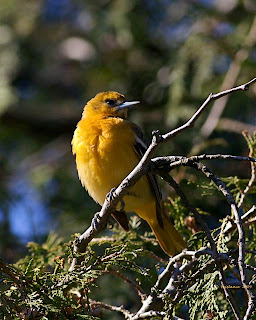
THE MIGRATION CONTINUES


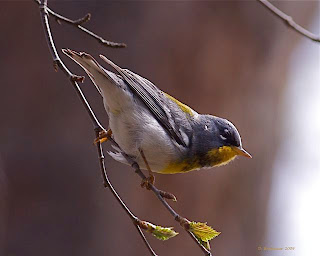
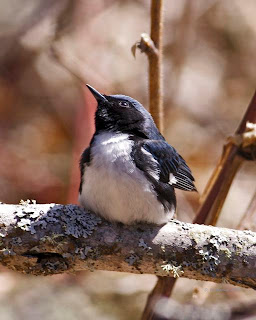
The bird migration, specifically the return of the warblers has been continuous and on track.  The wood warblers have flown in almost to the day of previous years and so far we have tallied 19 different species.

I hope you enjoy the new additions to Cedar Ridge.


"All the wood-warblers are stunning, each in their own way."
D. Brislance

Monday, May 18, 2009

THE MIGRATION


The bird migration is in full swing and the warblers are here on the ridge in full force.  I have been out in the field each day photographing their colorful return.  
"A picture is worth a thousand words.".... so I hope you enjoy these images of spring....


                                   The prettiest bird on the page is my grandson Will... he is non migratory......
Ruby-throated Hummingbirds travel more than 2,000 miles to go from Panama to their breeding destination in Canada.